Artist Bio
John Paul Gardner is an internationally exhibited, award-winning mixed media artist whose work explores the interplay of nature and geometric abstraction. His notable solo exhibitions include In Starlight at the Peru State College Gallery in Peru, NE; Vignettes at the Umpqua Art Center in Roseburg, OR; and Dissolve at the Portland Building Installation Space in Portland, Oregon. Recent juried exhibitions include Made in New York, Merged: d’Art’s in Virginia, Post It, Coupee in Belgium, and Works on Paper at Project Gallery in Toronto. His work has appeared in publications including Compression for Voya Collage Gallery and 100 More Prompts for the Brooklyn Art Library, and has been featured in LAHAR (Berlin). Gardner’s work is held in permanent collections including IMCAC in Santa Fe, the Rochester Museum of Fine Art, the Brooklyn Art Library, Light Work, and Peru State College. He holds an MFA from the University of Oregon and a BFA from SUNY Potsdam.
Artist Statement
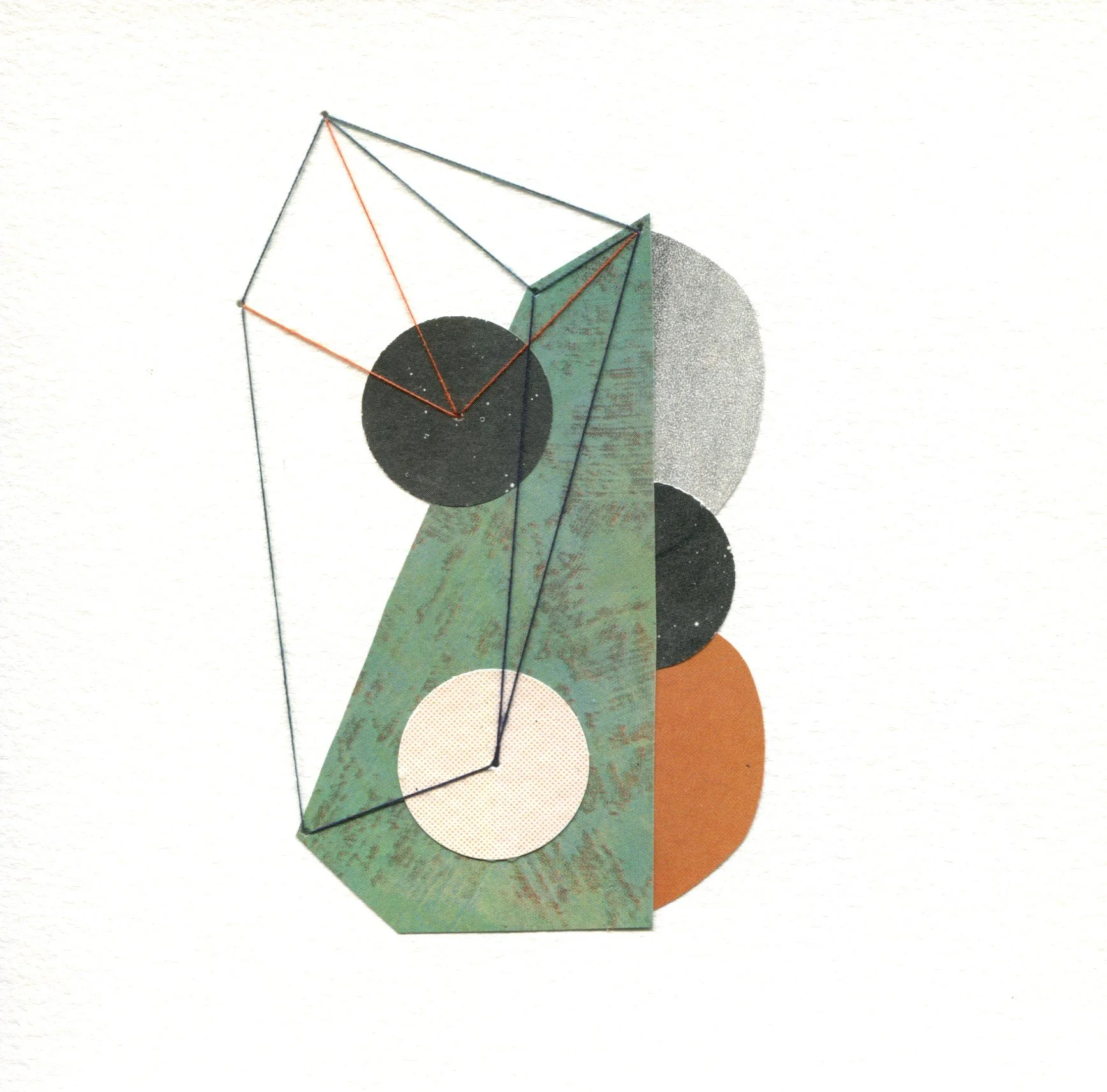
The Tilt series of mixed-media collages explore my relationship to the natural world through drawing, painting and collage. I find inspiration in the quiet structures found in landscapes, nature patterns, and geological formations. Each piece begins with an intuitive response to color, texture and form. The hand-painted papers, printed fragments, and precisely cut shapes become the foundation for compositions that hover between the organic and the architectural. Layered surfaces suggest shifting terrains, floating environments, and imagined ecosystems, while the stitched and drawn linework introduces a sense of connection, tension, and movement across the planes.
I enjoy natures patterns, rhythms, and inherent order that I then interpret in my works. Rather than depicting recognizable scenes, my artworks distill natural elements into essential forms and fragments. The results are circles that feel like celestial bodies, angled shapes reminiscent of cliffs or crystals, and networks of lines that evoke constellations, root systems, or structural frameworks. By reducing the natural world to geometry, the work reveals the underlying systems that shape our environments, inviting viewers to contemplate the quiet architecture of the world around them.
These pieces explore the balance between precision and play. The hard edges of the geometric forms interact with the softness of textured surfaces, creating tension between control and spontaneity. This series explores my interest to create works that map memory, observation, and imagination into visual spaces that feel both grounded and otherworldly.